
Family Legends: Where Memories End and Real Family History Begins

Almost every family has a story that no one can prove anymore, yet everyone continues to repeat.
In one family, a great-grandfather is said to have belonged to a noble lineage. In another, a great-grandmother was believed to be the daughter of a wealthy merchant. Others tell stories about a famous ancestor, a connection to a well-known surname, or a family link to a historical figure.
Over time, these stories become part of a family’s identity. They are shared at holiday gatherings, passed down to children and grandchildren, and even recorded in family trees. Eventually, no one remembers who first told the story—or what evidence it was originally based on.
But can a family legend be considered a reliable historical source?
Memories alone are not enough. However, almost every family legend can become a valuable starting point for genealogical research.
Why Family Stories Shouldn’t Be Dismissed
Family memories are rarely pure fiction. Even when the main story turns out to be inaccurate, it often preserves valuable clues, such as:
a surname or nickname;
the name of a town, village, or factory;
an ancestor’s occupation;
an approximate migration date;
a story about military service;
membership in a particular social class;
the name of a long-forgotten relative.
The problem is not that our relatives intentionally tell false stories. Most often, they simply repeat what they themselves were told.
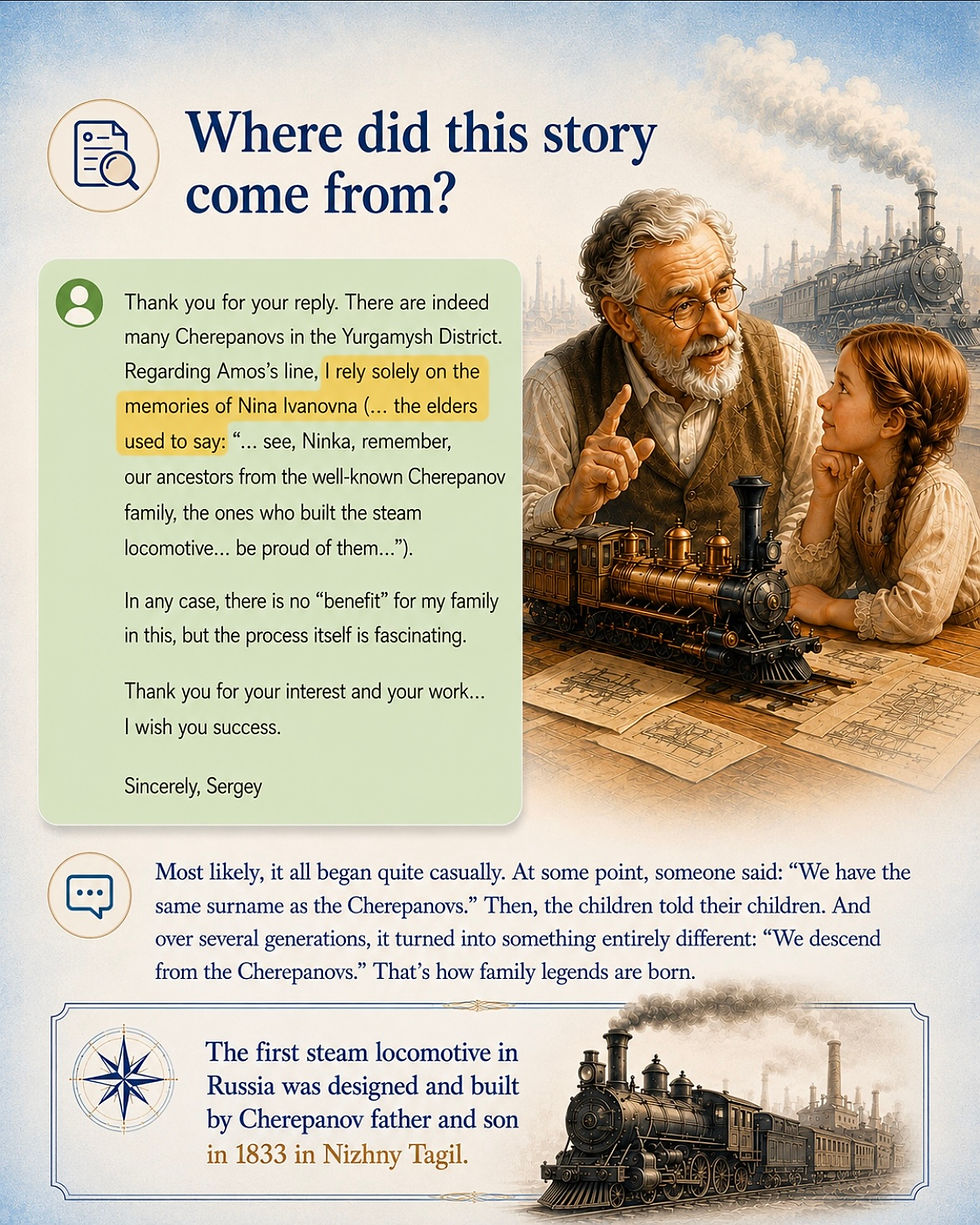
After several generations, the meaning of a story can change dramatically. “Our family had the same surname” gradually becomes “We were related.” A wealthy ancestor turns into a successful merchant. Someone who merely worked alongside a famous family eventually becomes a direct relative in the family narrative.
That is why a family legend should neither be accepted blindly nor rejected immediately. It should be treated as a hypothesis—one that can be tested using historical records.
How a Shared Surname Turns Into a Family Connection
The same surname and the same hometown can seem like convincing evidence. It feels natural to assume that two families must be related.
In genealogy, however, sharing a surname is only the beginning of the investigation.
The same surname may have appeared independently in several unrelated families. In large cities, industrial settlements, and rural communities, dozens of unrelated people could carry the same surname. In addition, surnames often changed over time, were recorded in multiple spellings, or became fixed much later than researchers expect.
To prove a relationship, every generation must be documented step by step—from a known individual to their parents, grandparents, great-grandparents, and beyond.
You cannot skip a generation and connect people simply because they share a surname. The connection must be supported by documented evidence.
The Cherepanov Family Story
One day, I received a message from someone whose family had passed down a story for many years claiming they were related to Yefim and Miron Cherepanov—the creators of Russia’s first steam locomotive—who are also my direct ancestors eight generations back.
At first glance, the story sounded convincing. The surname matched, Nizhny Tagil appeared in family memories, and older relatives confidently told younger generations that they belonged to the famous Cherepanov family.

Rather than agreeing or arguing, I began researching the claim.
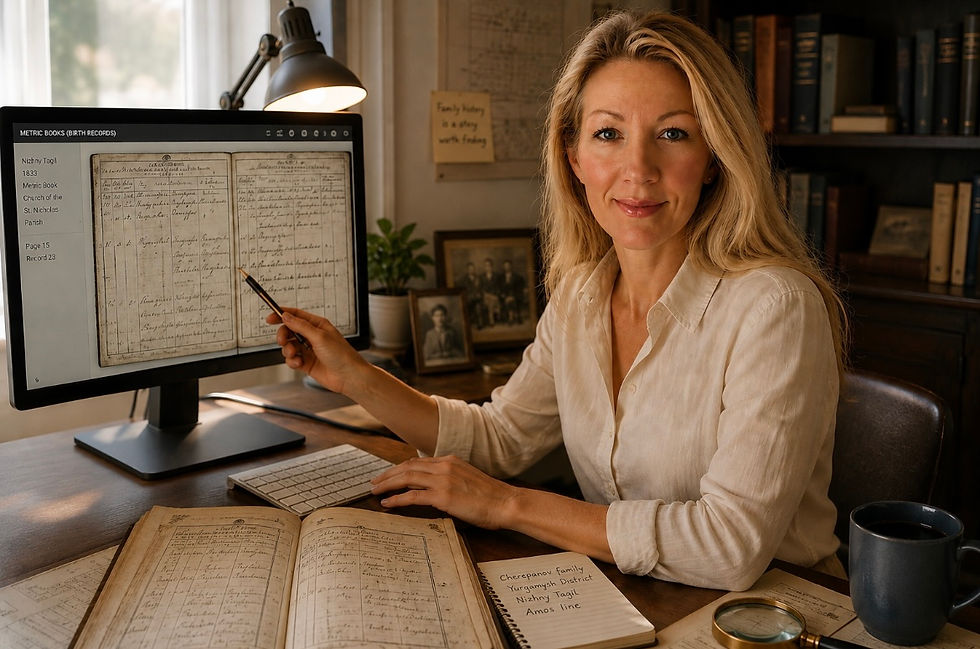
I traced several generations of the Cherepanov family, examined birth, marriage, and death records, compared family groups, and searched for documentary evidence connecting the two branches.
The research included parish registers (metric books), revision lists, and other archival records. I analyzed not only individual names but also family structures, children’s ages, places of residence, and possible marriage connections.
In the end, I found no document confirming the alleged relationship.
Yet the absence of evidence did not make the research unsuccessful. On the contrary, it revealed how the family legend may have originated—and why it had been accepted as fact for generations.

What Counts as Evidence in Genealogy?
Genealogical research is built on documented sources rather than attractive stories.
To reconstruct a family’s history, researchers commonly use:
Parish Registers (Metric Books) – recording births, baptisms, marriages, and deaths. These records often reveal family relationships, maiden names, places of origin, and godparents.
Revision Lists – showing household composition, ages, movements between revisions, migrations, and changes in social status.
Confession Lists – listing families by parish, often including ages and relationships between household members.
Population Censuses – providing information about household members, occupations, literacy, birthplaces, and other valuable details.
Military Records, Service Files, Employment Records, and Personal Files – often containing biographical information, family members, education, and places of residence.
Archival Files and Local Historical Sources – including resident lists, factory records, migration files, court records, land documents, and many other valuable sources.
Rarely does a single document tell the whole story. Reliable conclusions come from comparing many different records.

Why an Unconfirmed Legend Isn’t a Disappointment
Most people begin their research hoping for a simple answer: Was the family legend true or false?
Real genealogy rarely offers such simple conclusions.
Instead, the research may reveal that your ancestors lived in another village, belonged to a different social class, used another spelling of their surname, or had a completely unexpected life story. You might discover your great-great-grandmother’s maiden name, a second marriage, a migration, an adoption, or relatives your family never knew existed.
These discoveries are what make family history truly meaningful.
A famous surname may sound impressive, but the real journey of ordinary people through wars, migration, hard work, and family hardships is often far richer than any legend.
An ancestor’s value is not defined by a noble title or proximity to a famous person. Their value lies in the fact that their life became part of your family’s story.
Where Do Family Legends Come From?
There are many reasons.
Sometimes relatives misunderstood what they had heard. Sometimes stories about several people became merged into one. Very often, people with the same surname were simply assumed to be relatives.
In other cases, family history was intentionally altered. Certain facts were hidden to protect children, while other relatives gradually disappeared from family memory because speaking about them became too painful.
For this reason, differences between family memories and archival records do not always mean that someone was wrong. Sometimes they point to an important historical event that has yet to be uncovered.
How to Begin Verifying a Family Legend
Start by writing down the story exactly as it has been passed down.
Do not correct it or try to make it more logical.
Instead, record:
who told the story;
when and where it may have happened;
every surname and personal name mentioned;
the towns or villages associated with the family;
which generation the supposed ancestor belonged to;
what documents or photographs have survived.
Only after that should you begin building a documented family line from yourself back through previous generations.
Starting with the famous historical figure is usually the wrong approach. It is far more reliable to work from the known toward the unknown—from your own documents to your parents, grandparents, and then earlier generations.
That way, your family tree is built on evidence rather than assumptions.

How I Can Help You Discover Your Ancestors
My name is Ekaterina Brouard, and I specialize in genealogy, archival research, and reconstructing family history, primarily for families whose roots lie within the former Russian Empire, the Soviet Union, and modern-day Russia.
My services include:
verifying family legends and suspected family connections;
locating birth, marriage, and death records;
identifying maiden surnames;
reconstructing family lines using parish registers, revision lists, and confession records;
researching places of residence, social status, and migration history;
identifying the correct archives and record groups for further research;
building family trees;
providing consultations for people conducting their own genealogical research.
Research may begin with a single archival record or expand into a comprehensive study of an entire surname or family branch.
Whether you already have a family tree, photographs, documents, or only family stories, I can help evaluate the available evidence and identify the next step. If you are just beginning, I can help create a clear research plan based on the information you already have.
A Family History Worth Passing On
The true goal of genealogy is not simply collecting names.
It is understanding where people lived, how they earned their living, why they moved, how they built their families, and which historical events shaped their lives.
That is how a family tree becomes a family story.
Today, we have the opportunity to preserve not only names and dates, but also documents, photographs, memories, and archival discoveries. Future generations can inherit something far more valuable than another unverified legend—they can inherit a family history built on real historical evidence.
Family stories deserve to be remembered.
Sometimes, the best way to preserve them is to discover what really lies behind them.
What Family Legend Has Been Passed Down in Your Family?
Perhaps you’ve heard a story about noble ancestry, merchant origins, a distinguished historical figure, a famous surname, or a mysterious relative whose fate remains unknown.
Even if the original story turns out to be inaccurate, archival research may uncover a family history far more fascinating than anyone ever imagined.
Comments